



Are wind speeds the same over land as they are over the ocean?
The answer is NO! They are not the same. The accompanying graph will help to show this.
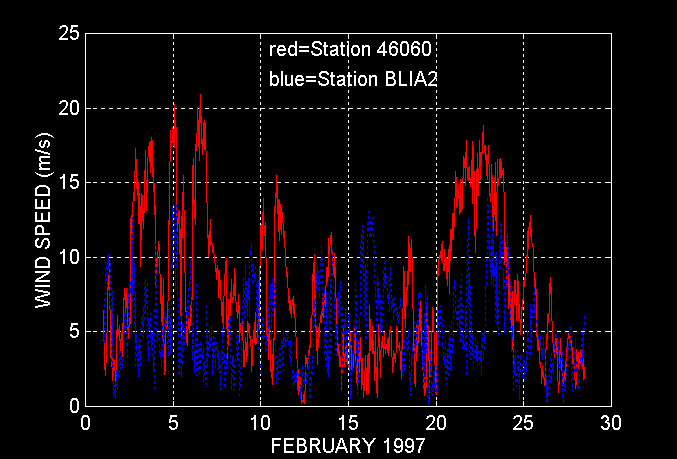
This graph shows wind speeds measured at two locations within 16 miles of each other. Station 46060 is a buoy which is located on the water in the Gulf of Alaska. Station BLIA2 is a land-based station situated on the coast of the Gulf of Alaska. As you can see, the wind speeds from Station 46060 are greater in magnitude than the speeds from Station BLIA2.
The reason this is so is that the characteristics of the land surface such as trees, plants, buildings, sand, mud, and rocks slow the wind because of the friction that exists between the wind and the land surface.
You can test the effects of friction by doing three simple exercises:
- First, go into a carpeted room (or outside on the grass) and try to slide your fingertips across the carpet (or grass). Doesn't it seem rough? Isn't there some sort of resistance or friction to your hand easily gliding across the surface?
- Second, go to a table or a desk. Slide your fingertips across the tabletop or desk surface. Doesn't your hand glide across the surface fairly easy?
- Third, pour some water on the table or desk. Again, slide your fingertips across the surface. Isn't it "slipperier" than when the tabletop or desk was dry?
So, from our experiment, we can conclude that carpet and grass provides more friction than a table or a desk. We can also conclude that a wet table or desk has less friction than a dry table or desk.
Return to Science Education Home
 NDBC on Facebook
 NOAA on LinkedIn
 NDBC on Twitter