



Deep-ocean Assessment and Reporting of Tsunamis (DART®)
Bottom Pressure Recorder
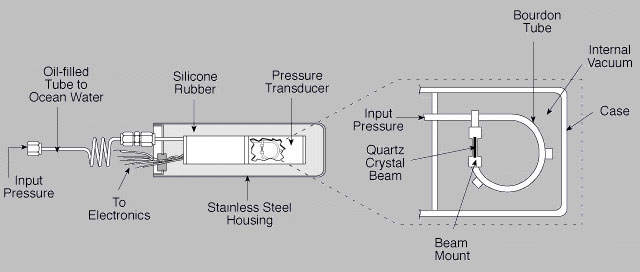
The tsunami BPR uses a pressure transducer manufactured by Paroscientific, Inc. These transducers use a very thin quartz crystal beam, electrically induced to vibrate at its lowest resonant mode. This oscillator is attached to a Bourdon tube that is open on one end to the ocean environment. As a tsunami wave crest passes over the instrument, the increased pressure causes the Bourdon tube to uncurl, stretching the quartz crystal and increasing the vibrational frequency. Conversely, the passage of a tsunami trough reduces the pressure, allowing the Bourdon tube to curl more tightly, thereby compressing the quartz crystal and lowering the vibrational frequency. These quartz crystal vibrational frequency changes can be measured very precisely by the electronics system of the tsunami gauge and the frequency changes are then converted into the corresponding changes in tsunami height. For periods greater than a minute or so, and for deployments at depths of 5000 m, the transducer is sensitive to changes in wave height of less than a millimeter.
 NDBC on Facebook
 NOAA on LinkedIn
 NDBC on Twitter